
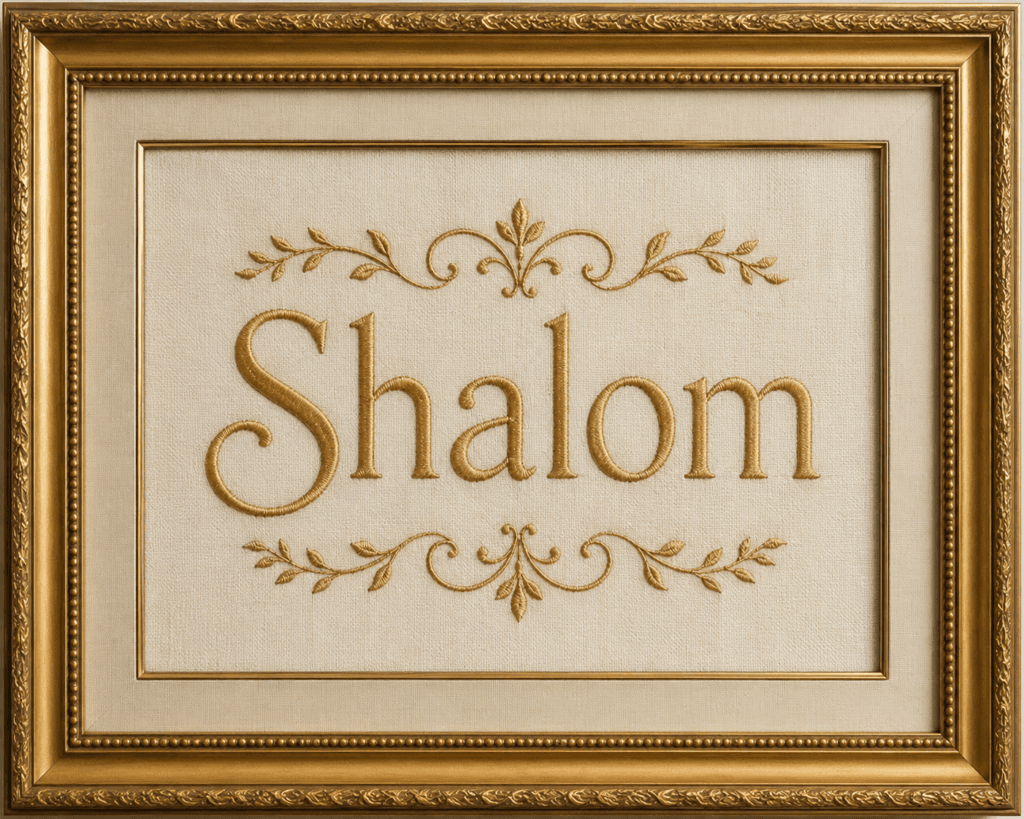

Grandma’s embroidery of the word ‘Shalom.’ Photo: ChatGpt
Takeaways
- Shalom means wholeness, order, and a name of God, far beyond “peace.”
- You can’t hang God’s name in a bathroom. That’s the actual rule.
- The word comes from shalem, meaning whole or complete.
- Shalom is both “hello” and “goodbye” in Hebrew.
- Jewish tradition holds that ‘Shalom’ is one of God’s own names.
My friend Rachel almost had a full meltdown over a piece of embroidery.
Her grandmother stitched the word Shalom decades ago, framed it in a cheap gold frame, and it hung in every apartment the family ever lived in. When Rachel inherited it, she did what anyone would do. She hung it in her downstairs bathroom, because that’s where guests actually look at the walls.
Her uncle saw it during a visit and froze mid sentence, staring at the wall like it had personally offended him.
Wait, You Can’t Hang That WHERE?
He had a real reason to react that way. In Jewish tradition, Shalom is treated as one of the names of God, far beyond a word for peace. Jewish law actually states this directly, teaching that peace is God’s own name.
That single fact changes everything about where you can put it.
Sacred names don’t belong in a room associated with the bathroom. It’s the same reason you won’t find a mezuzah on a bathroom doorpost, even though every other doorway in a Jewish home gets one. The rule (according to Jewish tradition) stays fixed. The frame just has to find a different wall.
Rachel relocated the frame to her hallway that same afternoon. Problem solved, grandmother honored, uncle relieved.
📖 Read this article about the true meaning of ‘Am Yisrael Chai.”
So What Does Shalom Actually Mean?
Here’s where it gets good. Shalom means far more than the absence of conflict. The word comes from the Hebrew root shalem, which means whole, complete, or nothing missing. Peace, in this worldview, means everything being in its proper place, well beyond quiet.
Think about that for a second. A ceasefire is the absence of fighting. Shalom is restoration.
(image)
Five Things You Probably Didn’t Know About Shalom
- It means both hello and goodbye. Hebrew speakers use shalom the same way English speakers use “hi” and “bye,” which shows how deeply woven into daily life the concept of peace really is.
- It’s connected to repayment and restitution. The root shalem also relates to paying something back in full, which strengthens the idea that shalom is about making things whole again.
- Shabbat Shalom carries a blessing inside it. It’s a wish for wholeness over the entire day of rest, layered on top of the greeting.
- Numbers 6:26 uses it in the priestly blessing. God gives peace, and in that context, peace means blessing, security, and divine favor combined.
- Some traditional sources restrict writing it casually. Because of its status as a divine name, there are real limits on where and how it gets written in sacred contexts.
What the Bible Itself Says About Shalom
The word shows up again and again in the Hebrew Bible, and every time, it carries this fuller weight.
Numbers 6:26 ends the priestly blessing with “and give thee peace,” tying shalom directly to God’s favor and protection.
Psalm 29:11 says “the LORD will bless his people with peace,” pairing shalom with strength as a gift God hands over.
Isaiah 26:3 promises “perfect peace” for a mind fixed on God, using shalom shalom, doubled up for emphasis.
Even King Solomon’s name, Shlomo in Hebrew, comes from this same root. 1 Chronicles 22:9 records God promising peace and quiet for Israel during his reign, the same shalom stitched into his very name.
So Why Am I Telling You About a Bathroom Wall
I think about Rachel’s embroidery a lot, mostly because of what it teaches about reverence.
A simple word can carry so much weight that where you place it becomes a spiritual decision? Wow.
For anyone drawn to the roots of biblical faith, this is a small window into something bit. Shalom is a holy word. It describes a life restored, a home in order, and a blessing that carries God’s own name inside it…far beyond the meaning we’re used to (peace).
Rachel’s grandmother probably never imagined her stitching would spark a family debate decades later. But she’d likely be proud that the word still means something to the people holding onto it.
Want to keep reading? Read here to find out what keeping kosher actually means. Explore more on faith, values, and the Land of Israel at Sinai Project.
Discussion0
No comments yet — be the first to share your thoughts.