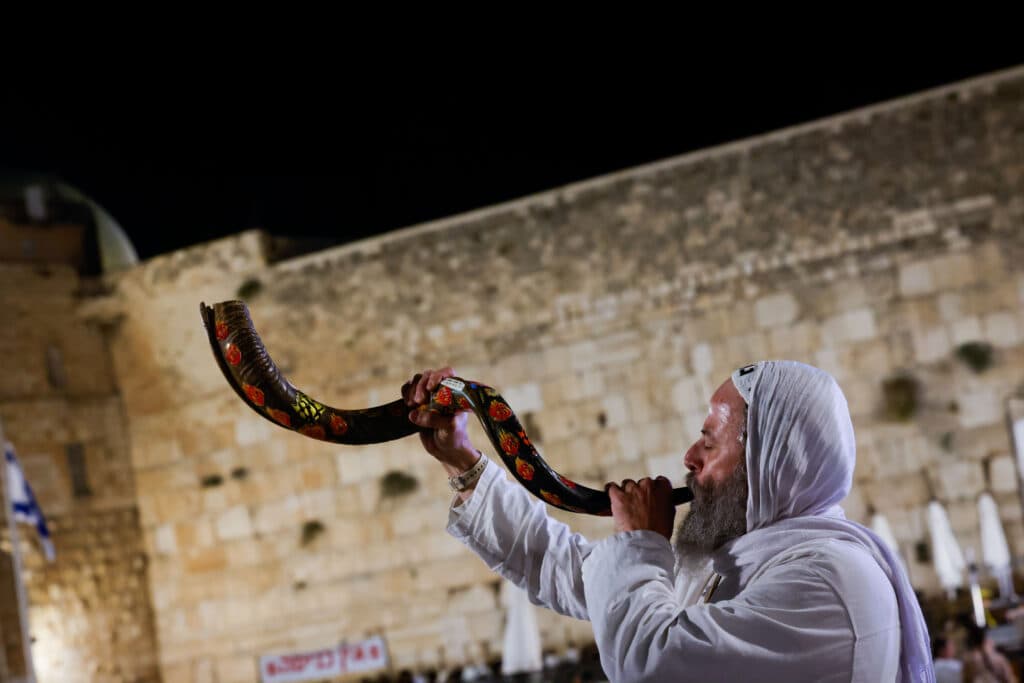

Two days before Yom Kippur, a Jewish man blows a shofar horn as Jews arrive for a forgiveness prayer (Selichot), at the Western Wall in the Old City of Jerusalem, October 9, 2024 | Photo: Chaim Goldberg/Flash90
- Repentance in Judaism is about direction, not distance.
- The Hebrew word teshuvah literally means “return.”
- Every wrong choice pulls a person further from God, one step at a time.
- The moment you decide to turn back, you’re already closer, even before you’ve gone anywhere.
- No mediator is needed. The process happens directly between a person and God.
Somewhere right now, someone is running a mental replay of this past year, the mistakes, the missed moments, the things they wish they’d said differently. Jewish communities everywhere are gearing up for the one day that turns that replay into something useful: Yom Kippur, the day repentance stops being a private ache and becomes an actual, doable practice.
If you’re unfamiliar with the holiday, here’s the short version: no work, no food, no water, from sunset to sunset. The fasting isn’t the point. It’s what happens when a body gets out of the way so a soul can think clearly.

Teshuvah: A Return, Not a Rebuild
The word most people reach for is “repentance,” but the Hebrew word is teshuvah, and it comes from a root meaning “to return.” Jewish tradition teaches that every person is born with a pure soul. Every wrong choice doesn’t erase that soul. It just adds distance, one step at a time, moving a person further from God. Teshuvah is the decision to stop adding distance and start closing it.
A Parable: The Two Travelers
Picture two people leaving the same hometown on foot, walking the same road. The first sets out alone. An hour later, the second follows the same path.
By the time the second traveler starts walking, the first is already an hour ahead. But then the first traveler stops, turns around, and starts heading back toward home.
Here’s the question worth sitting with: at that moment, who is closer to home?
Physically, the second traveler is closer. He’s an hour behind the first, still on the outbound road. But he’s still walking away. The first traveler, meanwhile, has turned to face home and started moving toward it.
Jewish tradition says the first traveler is closer, because direction matters more than distance. The moment a person decides to return, they’re already turning toward God, even before they’ve covered any ground. Someone who makes that decision is called a baal teshuva, a master of return, and Jewish sources go so far as to call this person a tzaddik gamor, a fully righteous person, precisely because of the turn, not because of a clean record.
The Steps, According to Tradition
Ancient sages, following the medieval scholar Rambam, broke the return into concrete steps:
- Charatah (regret): sorrow rooted in what the choice cost your relationships and your own soul, not fear of getting caught.
- Azivat ha-chet (abandoning the sin): actually stopping. Feeling bad without changing course doesn’t count.
- Vidui (confession): saying the wrong out loud, plainly, no soft language.
- Kabbalah le’atid (commitment): resolving not to repeat it, and seeking forgiveness from anyone you hurt before turning to God.
A Teaching Worth Carrying Into the Day
The 13th-century sage Rabbeinu Yona described what this return can feel like: “he will let go of all the sins he has committed and see himself as if he were born that very day, with neither good deeds nor sins to his name.” A newborn baby has never sinned. That closeness to God is the purest state a soul can hold. A baal teshuva returns to that same closeness, not because the past disappears, but because in God’s eyes, the turn brings him back to it.
Quick Q&A
Is Yom Kippur sad or hopeful? It’s hopeful. A sin stains the soul, and without repentance, that stain stays there forever. Yom Kippur is a gift from God: a person who has done the inner work of repentance is promised that the stain will be wiped clean, without a trace left behind.
Do you need a rabbi to repent? No. The process is direct, person to God, with one exception: if you wronged another person, you go to them first.
Is this only a once-a-year thing? The holiday concentrates it, but the turn itself is meant for every single day.
Every person carries a road behind them, some stretch longer than others, some messier. None of that determines how close one can get to God on Yom Kippur. All it takes is the turn. When we take that first step back, Heaven meets us the rest of the way. That’s Jewish repentance. That’s Yom Kippur.
Discussion0
No comments yet — be the first to share your thoughts.