Secrets of the Jewish Calendar Part 6: Why Are Candles Lit for Eight Nights?

Rabbi Avi Baumol
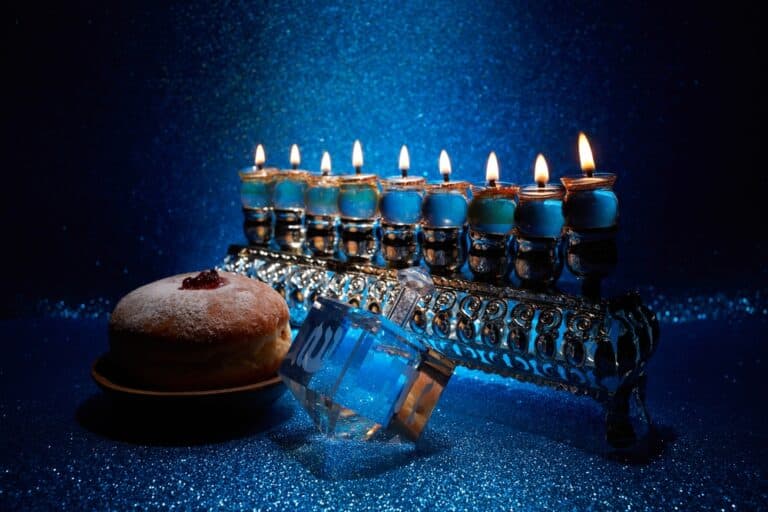
Chanukah menorah, dreidel, and sufagniah (traditional holiday doughnut). | Photo: Shutterstock
From Rosh Hashanah to Chanukah
The month of Tishrei is replete with Jewish festivals and was a time of great harvest during the ancient agricultural cycle. Upon completion of that month, usually falling in September or October, Israelites plant for the following year’s crops and pray for the rainy season to begin. How important is rain to the land and inhabitants of Israel in ancient times? Extremely!
The Mishna has one entire book (Taanit) dedicated to these prayers and the drastic measures required if rain does not come. Seen as a curse by God, the nation of Israel must immediately begin to repent and even refrain from eating and drinking in order to elicit God’s compassion and for rain to come and replenish the seeds. The months following the high holiday season represent the test to see whether God responds to our prayers and provides rain in the proper time.
The month following Tishrei is called Marcheshvan. There are no holidays in this month but the following one, Kislev, has within it a joyous festival called Chanukah.
Fighting to Preserve Jewish Traditions
The Chanukah story took place over 2100 years ago, in the land of Israel when it was occupied by the Syrio-Greeks. The Greeks, led by the evil king Antiochus, made terrible decrees against the Jews, preventing them from studying Torah or performing Jewish rituals such as circumcision. They even put idols into the Temple. There were Jewish priests who were influenced by the Greeks called Hellenists who wanted to remove all of the Jewish laws and customs from Judaism and instead wanted to live as non-Jewish Greeks.
Matityahu, a priest from the city of Modiim, rose up and started a revolt in order to return the Temple to sanctity and purity. In order to do that he needed an army; it began with him and his five sons—Shimon, Elazar, Judah, Jonathan, and Yochanan.
Over the course of a year the leader of the small band of these Jewish warriors, Judah, who called himself the Maccabee (the hammer), successfully defeated small battalions of Greek armies who came to quash the rebellion. He did so through mastery of the terrain and understanding warfare of his own land as opposed to a foreign enemy. Judah managed to win five decisive battles and after the fourth he returned to the Temple, defeated the Hellenists, cleaned out the Temple of idols and impure things and rededicated the Temple to God. The rededication in Hebrew is called Chanukah, and it took place on the 25th day of the month of Kislev (usually in the month of December).
A Great Miracle Happened
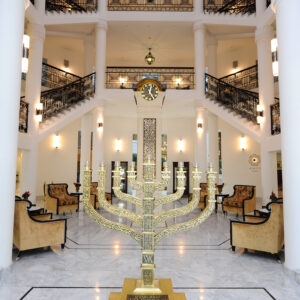
The symbol of the Temple, and of God’s presence resting there, was the daily lighting of the Menorah, the seven branched candelabra which illuminated the Temple. According to one story found in the Talmud, Judah and his brothers came into the Temple and sought to relight the Menora but they only found one cruise of oil which would last one day. They were dejected because it would take eight days to travel up north and return with pure oil, untainted by idolatrous hands. A miracle took place and the Menorah lasted for eight days instead of one.
For this reason, it was decided that Jews all over the world would celebrate Chanukah as a national victory over the Greeks as well as a rededication of the Temple. The symbol would be a Menorah but they added one branch to make it have eight branches in honor of the eight-day miracle.
Jews today celebrate Chanukah by lighting the Chanukiah, an eight-branched menorah, each night of the eight-day festival. Starting with one candle on the first night, (placing it on the right side and then lighting from left to right each additional night) an additional candle is lit each subsequent night until all eight candles are kindled on the final evening.
The ninth branch, called the shamash (helper), is used to light the other candles and is placed higher or set apart from the rest to distinguish it. The lighting of the Chanukiah is a central mitzvah of Chanukah and serves to fulfill the principle of publicizing the miracle of the oil that lasted eight days in the rededicated Temple.
Watch Chanukah celebrations in Mamilla, Jerusalem near the Old City:
These Lights are Holy
As stated in the blessing Hanerot Halalu, “These lights are holy… we kindle them to commemorate the miracles, wonders, and acts of salvation performed for our ancestors.” Through this ritual, Jews connect with their history, celebrate divine providence, and draw lessons of resilience and faith into their lives today.
Discussion0
No comments yet — be the first to share your thoughts.