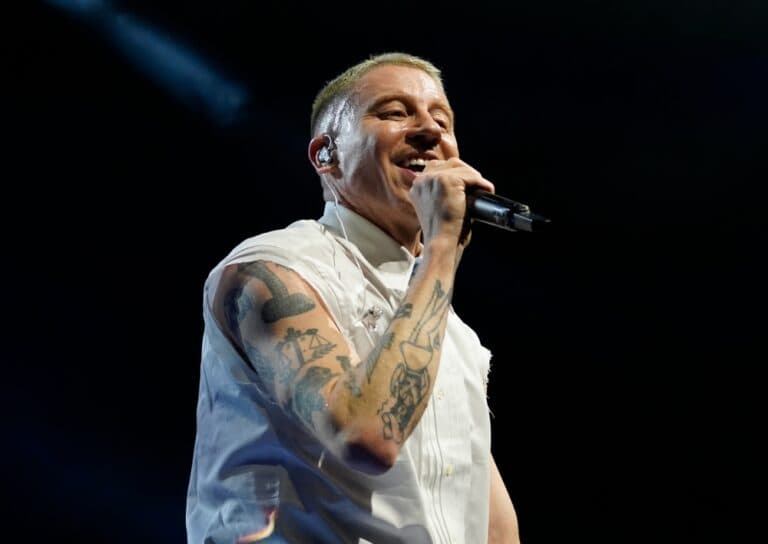

US-Rapper Macklemore performs on stage at OVO ARENA Wembley on April 12, 2023 in London, UK | Photo: Shutterstock
Takeaways
- A costume, not a coincidence. 2014’s hooked-nose caricature still follows him.
- Kraft said the quiet part. A documented history of antisemitic rhetoric, not just politics.
- One condemnation, then silence. Hamas got a mention. The Bibas children never did.
- The money talks. Part of his $1M goes toward a group tied to UNRWA.
- The timing talks too. Relevance was fading before this controversy revived it.
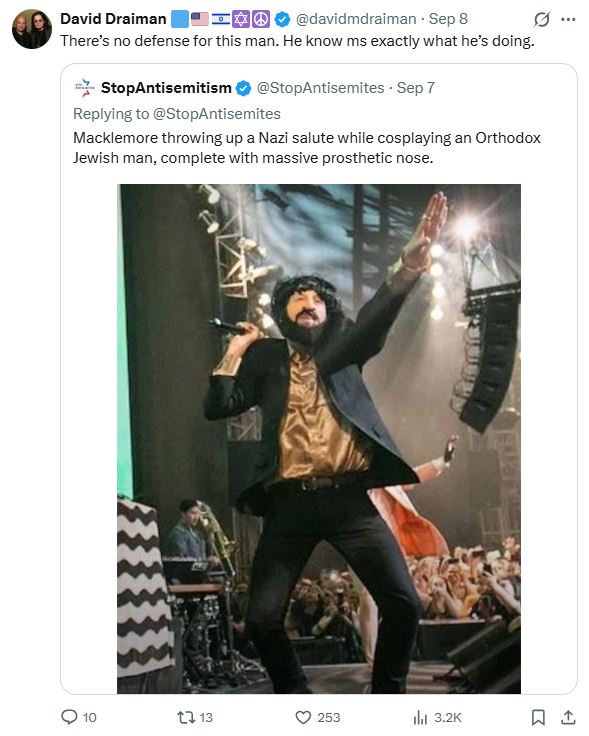
A decade ago, Macklemore walked onstage in Seattle wearing a wig, a fake beard, and a prosthetic hooked nose. The crowd laughed. Nobody in the arena that night could have guessed this costume would resurface as evidence in a controversy over Robert Kraft’s stadium and a canceled Ed Sheeran tour date.
That image never went away. It sits underneath everything that came after.
The Costume He Never Fully Answered For
The 2014 performance is often described as satire gone wrong. But Jewish audiences recognized something specific: a rabbinical stereotype built from features used for generations to mock Jews. Macklemore apologized and said he never intended to portray a Jewish stereotype. The apology didn’t erase the image, and it became the first data point in a pattern that would keep repeating.
What He Said, and Didn’t Say, After October 7
On October 19, 2023, Macklemore posted a statement condemning the Hamas attacks. In the same breath, he accused Israel of collective punishment against Gaza. That was, functionally, the last time he gave Hamas comparable weight to anything else in the conflict.
Two weeks later, at a Washington rally, he told the crowd he was still learning the history but already had his conclusion: “I don’t know enough. But I know enough that this is a genocide.” From that point forward, his public statements stopped mentioning Hamas by name, stopped mentioning the hostages, and stopped mentioning Ariel and Kfir Bibas, the two youngest children Hamas murdered after dragging them from Nir Oz. Seven months later, he released a song built around the word “resistance,” the same framing Hamas and its supporters use for October 7 itself.
Kraft’s Statement Was Deliberately Precise
Coverage of Macklemore’s removal from Ed Sheeran’s shows leaned hard into a “Free Palestine” narrative, and Macklemore leaned into it too, framing himself as a man punished for speaking up. But Robert Kraft’s own statement named three things: recent onstage material, content shown during New Jersey performances, and a documented pattern of antisemitic rhetoric and imagery. Kraft said Gillette Stadium has no obligation to host hate speech, and much of the press coverage that followed mentioned the Palestine advocacy in the headline while burying that second half of Kraft’s reasoning several paragraphs down, if it mentioned it at all. That framing choice let Macklemore’s version of the story travel further than Kraft’s.
Where the Money Actually Went
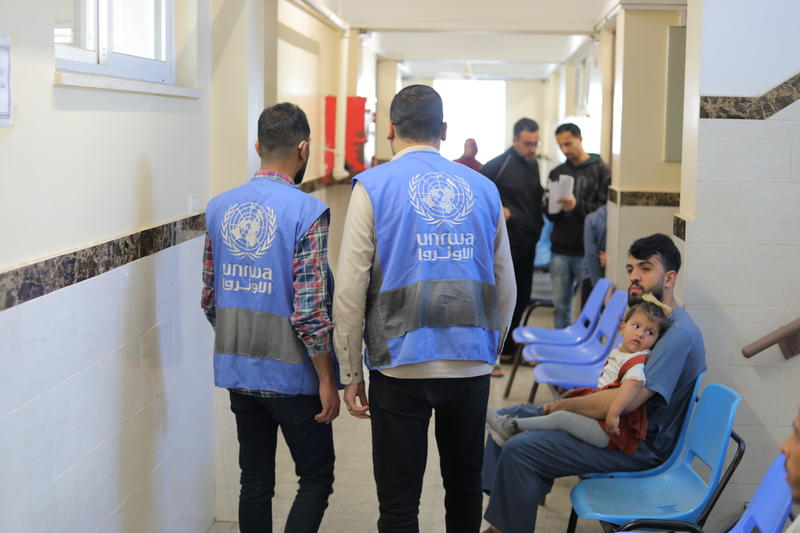
Macklemore pledged his $1 million net earnings from the tour to six organizations. One of them is the UNRWA USA National Committee, the American fundraising arm of UNRWA, the UN agency operating in Gaza. UN Watch, the Geneva-based monitoring group, has documented what it calls thousands of Hamas-affiliated employees inside UNRWA’s Gaza operations, and has separately alleged that at least 1,500 Hamas members work for the agency there. A US federal watchdog, USAID’s inspector general, confirmed that more than 100 current and former UNRWA staffers were directly tied to the October 7 massacre, including school principals who doubled as Hamas battalion commanders. This is the organization Macklemore chose to fund, by name, in public, while asking Robert Kraft to match him.
Anti-Zionism as a Shield
Onstage, Macklemore told audiences that calling Israel an apartheid state and accusing it of genocide isn’t the same as attacking Jewish people. He has repeated versions of that line whenever Jewish observers, including many with no stake in Israeli politics, called his imagery and rhetoric antisemitic. Words alone don’t settle that question. A performer with this specific history, funding this specific agency, aimed at this specific target, earns scrutiny rather than a pass, no matter how many times he insists the two are unrelated.
Relevance Dressed Up as Conscience
Here’s a fact worth sitting with: before this controversy, most Americans outside hip-hop circles couldn’t have named a Macklemore song released after 2016. His $1 million pledge landed at the exact moment headlines needed a new angle on him. Robert Kraft was even invited to match the donation, guaranteeing another news cycle. A gesture that photographs well isn’t the same as a reckoning with a decade of imagery, a fully abandoned mention of Hamas’s victims, and a check written to an agency Hamas has openly exploited.
The Story Comes Back Around
That Seattle stage, that wig and prosthetic nose, wasn’t a one-off. It’s the same pattern now playing out in stadiums, wire transfers, and headlines a decade later, just with better PR and a more sympathetic press cycle. Jewish concern here isn’t a reaction to criticism of Israel. It’s a reaction to a specific artist’s specific record: a mocking costume, a single passing condemnation of Hamas followed by silence on its victims, a song celebrating “resistance,” and a donation to a group tied to the very massacre he once, briefly, said he condemned.
Discussion0
No comments yet — be the first to share your thoughts.