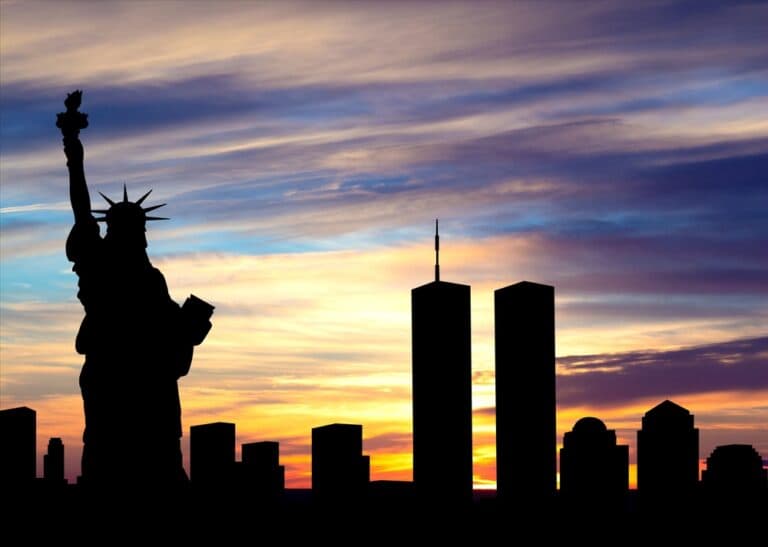

New York Skyline with the Twin Towers against the sunset | Photo: Shutterstock
Takeaways:
- 9/11 showed that pain travels far beyond its origin.
- Abraham Zelmanowitz’s choice to stay with his friend still stands as a picture of extreme good.
- Jewish tradition treats naming a threat honestly as an act of protection.
- 9/11 targeted Israel, Judaism, and the West all at once.
- Small, ordinary kindness is how a broken world gets rebuilt.
Every year on 9/11, people search for meaning in the wreckage. Jewish tradition, shaped by centuries of loss and rebuilding, offers three lessons that speak directly to that search.
We Belong to Each Other
The Talmud states that all people carry responsibility for one another. Rabbi Abraham Isaac Kook widened that idea into a circle that stretches outward until it holds the whole world.
9/11 proved the point without asking permission. A plot hatched in Afghanistan, carried out by men from Saudi Arabia, tore through New York and then rippled into homes and economies thousands of miles away. Grief travels far. Jewish teaching on prayer even says it should have windows, keeping a person open to someone else’s pain.
Name the Threat, Then Answer It With Good
One well-known Rabbi points to the story of Gedaliah, a leader who ignored warnings about a plot against him and paid with his life. The lesson is blunt: when someone says they want to destroy you, take them at their word.
9/11 also displayed extreme good alongside the hatred. Firefighters climbed stairwells while everyone else ran down them, and thousands of soldiers left their families and their own safety behind to fight the same threat overseas.
One story captures it best. Abraham Zelmanowitz, an observant Jewish computer programmer from Brooklyn, had a chance to evacuate and chose instead to stay with his friend and coworker Edward Beyea, a quadriplegic colleague who could not leave on his own. FDNY Captain William Burke Jr. reached them, sent his own firefighters to safety, and remained with both men until the North Tower collapsed at 10:28 a.m.

The Mishnah measures a single life as an entire world, so every one of those choices counted as a world saved. King Solomon wrote that God built creation so “one is opposite the other,” meaning every human capacity for evil carries a matching capacity for good.
That pairing, real evil met by real courage, is the same pattern Jewish history keeps returning to. Confronting danger honestly while choosing to protect life anyway is exactly the point.
Naming the Ideology Behind the Attack
Some parts of this story make people uncomfortable, but Jewish tradition has always valued clarity over comfort. The ideology behind 9/11 has a name and a long history, stretching from the Arabian Peninsula outward through centuries of conquest across the Middle East, North Africa and parts of Europe.

That expansion runs through the concept of jihad. A classic reference defines it as religious war meant to advance the faith and repel evil from believers, dividing the world into the land of Islam and the land of war. Groups like Hamas have said as much themselves. The Hamas Charter states plainly that renouncing any part of Palestine means renouncing part of the religion, treating territorial claims as a matter of faith rather than politics.

9/11 revealed that this ideology sets its sights far beyond one country. Israel sits at the center of its aim, but Judaism, the West, and the broader civilization built on biblical values all stand in its path. Recognizing that reality takes courage, and courage is exactly what Jewish tradition asks of its people. Naming a threat honestly is itself an act of protection, the first step toward safeguarding what deserves safeguarding.
Memory That Moves You Forward
What happened on that Tuesday morning stays, and grief from it can still find a direction.
Strengthening a family. Showing up for a neighbor. Choosing warmth over suspicion when suspicion would be so much easier. These are small acts, and Jewish tradition treats them as enormous. A single kindness, given freely, is how a broken world gets rebuilt one household at a time.
Carrying the Lesson Today
Twenty-plus years later, the takeaway stays concrete. Responsibility for one another, the courage of people like Abraham Zelmanowitz and Captain Burke, and the clarity to name a threat honestly remain the tools available to anyone who wants to answer tragedy and rise above it.
That’s the quiet inheritance Jewish tradition offers every year this date comes around, a way of living that turns memory into something worth carrying. We will never forget.
Discussion0
No comments yet — be the first to share your thoughts.