Experts Astonished to Discover an Ancient Rare Palm Tree That Survived in Israel
Findings from a two-year study of date palms in southern Israel reveal that an ancient lineage of date palms, rare on a global scale, has managed to survive in the land of the Bible. A rare species from a relict population of ancient wild date palms has been identified in Israel for the first time.

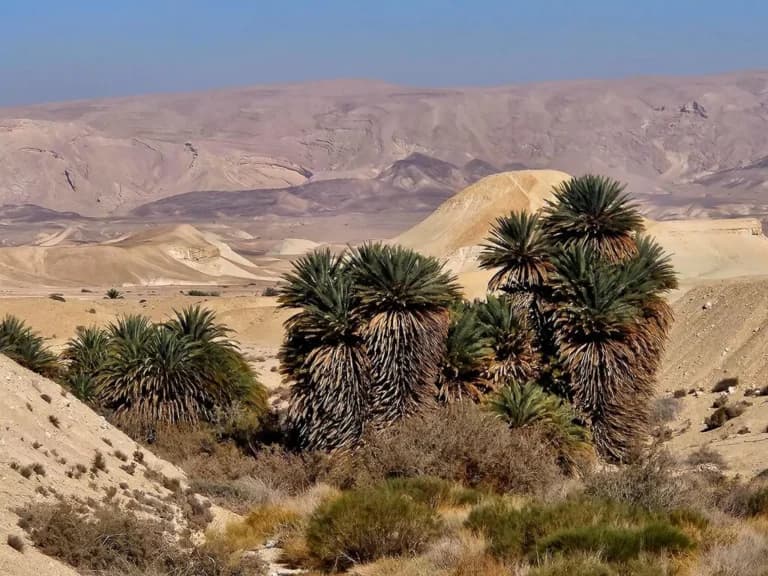
Findings from a two-year study of date palms in southern Israel reveal that an ancient lineage of date palms, rare on a global scale, has managed to survive in the land of the Bible.
A rare species from a relict population of ancient wild date palms has been identified in Israel for the first time. In a comprehensive study examining the genetic characteristics of date palms in southern Israel, an inter-university research team discovered that the rare wild date palm species Phoenix theophrasti – previously documented only in Crete and along the southwestern coast of Turkey – also exists in isolated oases in Israel’s southern deserts.
A Startling Discovery
This study, now garnering great interest among scientists, was conducted by a collaboration of the University of Haifa, Tel Aviv University, the Volcani Institute, and the Institute of Research for Sustainable Development (IRD) in France. For close to two years, dozens of samples of young leaves were collected from trees in 14 oases across the Negev (Israel’s large southern desert region) and the Arava (the desert valley that extends from the Dead Sea to Eilat). The prevailing assumption had been that, aside from a small and rare concentration of doum palms at the Evrona salt flats, all date palms belonged to the common cultivated species (Phoenix dactylifera).
Researchers were therefore surprised when genetic and morphological analyses of date palms growing near desert springs, long thought to be common date palms, revealed that some, in fact, are wild date palms closely related to Phoenix theophrasti. This marks the first documentation of this rare species in the southern Levant and significantly expands its known geographic range.
The study’s results indicate the presence of date palms with unique genetic profiles in oases along the Zin River and its tributaries, as well as notable genetic differences between isolated palms growing near springs and those found in established oases and along ancient trade routes.
Particularly prominent are the palm groups at Ein Ziq and Ein Shaviv, along with the surviving trees at Ein Zin and the Akrabbim Ascent. These preserve a relict genetic core of ancient wild date palms from a species previously unknown beyond the Mediterranean basin. The significance of this dramatic discovery is that a lineage of wild date palms – both geographically restricted and globally rare – has survived in Israel.
A Unique Variety
Phoenix theophrasti is named after the philosopher Theophrastus, Aristotle’s student and successor in the Peripatetic school and regarded as the “father of botany” in ancient Greece. Participants in the study included Prof. Guy Bar-Oz and Dr. Roy Galili from the University of Haifa; Dr. Merav Meiri from The Steinhardt Museum of Natural History at Tel Aviv University; and Dr. Ernesto Testa and Dr. Muriel Gros-Balthazard from the Institute of Research for Sustainable Development (IRD) in Montpellier, France.
The research was funded by Israel Chemicals Ltd. (ICL) as part of a class-action settlement requiring the company to pay for any environmental damage it caused in the Zin River. Within the framework of this settlement, a comprehensive and contemporaneous assessment of the date palm populations in the Negev and the Arava was conducted, including detailed genetic characterization.
“The genetic uniqueness of the Negev’s wild date palms likely points to an ancient center of distribution, adapted to the hyper-arid conditions of the Negev,” said Prof. Guy Bar-Oz. “The presence of the wild date palm Phoenix theophrasti in the Negev is important beyond local biodiversity. It has major implications for understanding the domestication process and spread of the cultivated date palm (Phoenix dactylifera). Previous genomic studies have shown that Phoenix theophrasti contributed genetic material to local varieties – including the Judean – and to North African varieties through ancient hybridization. This contribution likely influenced the adaptability and diversity of African date palms.”
The study’s findings will be presented at a conference set to be held on January 14, 2026, at the Vidor Centre in the Arava, named “Date Palms of the Springs”. More than 150 researchers, experts, date growers, and representatives of environmental organizations are expected to attend. The conference, organized by the Central Arava Regional Council, Desert and Dead Sea R&D and the University of Haifa, among others, will feature modern agricultural and agrotechnical research, lectures on the ancient cultural history of the date palm, environmental surveys on the condition of wild date palms, and reviews of ecological restoration and conservation efforts for the spring oases of the Arava.
This discovery is not only botanically exciting, but speaks to the land’s hidden richness, most especially as dates are traditionally considered the source of the honey mentioned in the Bible as one of the seven species of Israel:
“For the LORD your God is bringing you into a good land – a land with streams and pools of water, with springs flowing in valleys and hills; a land of wheat and barley, of vines and fig trees and pomegranates, a land of olive oil and honey.”
(Deuteronomy 8:7–8, NIV)
Discussion0
No comments yet — be the first to share your thoughts.