
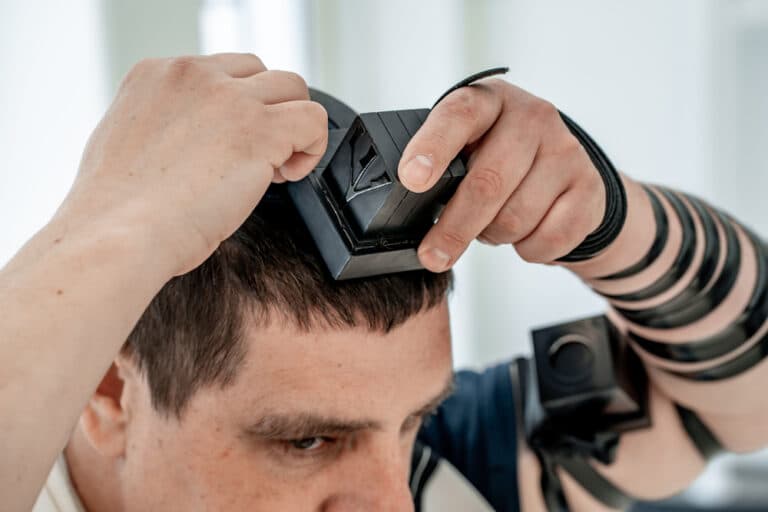

Jewish man placing tefillin on his head and arms | Photo: Shutterstock
Takeaways
- Tefillin are small leather boxes holding handwritten passages.
- Jewish men wear them on weekday mornings, never on the Sabbath or holidays.
- One box sits on the arm, near the heart. One sits on the head. They connect thoughts, emotions and actions to God.
- The black leather isn’t decoration. Jewish law requires it.
Somewhere over Greenland on a red-eye to Tel Aviv, my seatmate elbowed me. “What are those guys doing in the back? What’s with those black boxes” Ten men stood near the galley, leather straps wound around their arms, small black boxes strapped to their foreheads, swaying slightly as they prayed.
I’ve watched this scene my whole life. I grew up Jewish, with a father and brothers who did exactly what those men were doing every single weekday morning. Explaining tefillin (phylacteries) to someone who’d never seen them, mid-flight, with a tray table digging into my ribs, took a minute. Here’s what I told her.
What’s Inside the Boxes
Each box, called a bayit, contains parchment with four passages handwritten by a trained scribe. These passages come straight from Deuteronomy and Exodus, and they command remembering God and the exodus from Egypt.
The head box has four separate compartments, one passage in each.
The arm box holds all four passages together on a single piece of parchment, rolled and tied. A scribe can spend hours on a single set. Nothing about this is mass produced.
📖Read this article about why Jewish men wear tzitzit (strings) coming out of their shirts.
Why the Arm and Why the Head
The arm box goes on the upper arm, positioned so it sits near the heart. The head box rests above the forehead, right at the hairline. This isn’t random placement. It comes from a verse telling Israel to bind these words as a sign on the hand and as a reminder between the eyes.
The mind that plans, the heart that feels, and the hands that act, bound together and offered to God in a single, unbroken gesture.
Why Mornings, and Never on Saturday
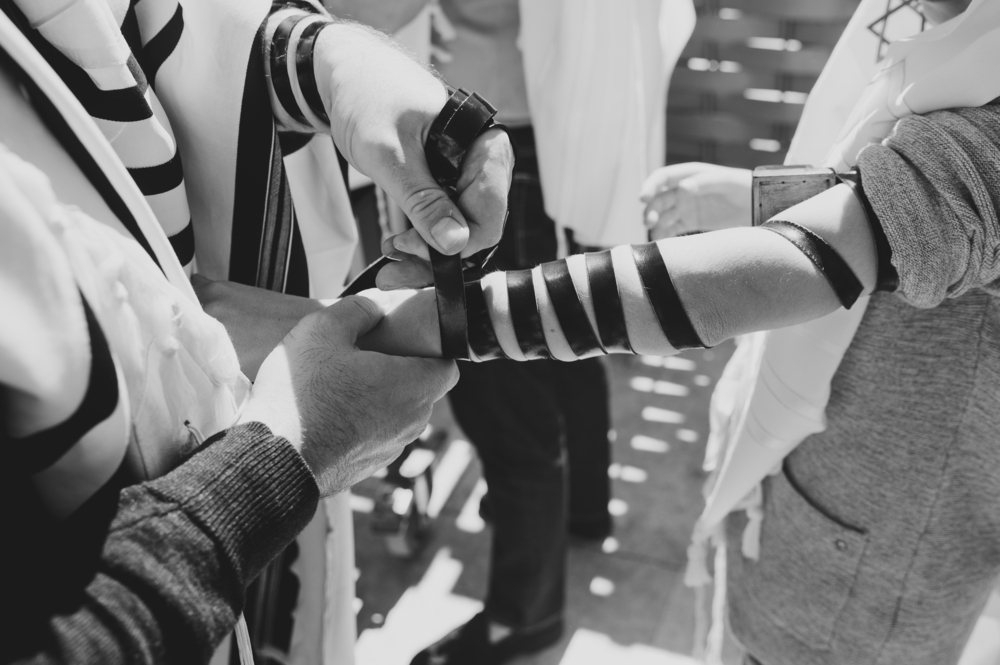
Tefillin are worn during weekday morning prayer only. Never at night, never on Shabbat, never on major holidays.
Those days already carry their own sign of the covenant, so tefillin step aside. That’s why you’ll see men wrapping up before sunrise on a Tuesday flight, but never on a Shabbat (Sabbath) morning in synagogue.

What About the Plane Thing
A few years back, a flight made an unscheduled landing because a passenger spotted the boxes and assumed it was a bomb! There was no bomb.
There was a teenager praying. It’s happened more than once, which says less about tefillin and more about how unfamiliar this practice still is outside Jewish communities.
Can Anyone Wear Them?
No. This is specifically a Jewish obligation, tied to the covenant given at Sinai, not a universal practice. You won’t find Jewish women wearing them in mainstream tradition, and it isn’t something meant to be adopted outside the Jewish community. Think of it less like a religious accessory and more like a covenant document you carry on your body.
By the time I finished, my seatmate just nodded and said, “That’s kind of beautiful, actually.” It is. A few thousand years of unbroken practice, still happening in the back of a plane at 35,000 feet, somewhere over Greenland, on a Tuesday morning.
Want to keep reading? Read here about why some Jews avoid being photographed on the Sabbath. Explore more on faith, values, and the Land of Israel at Sinai Project.
Discussion0
No comments yet — be the first to share your thoughts.