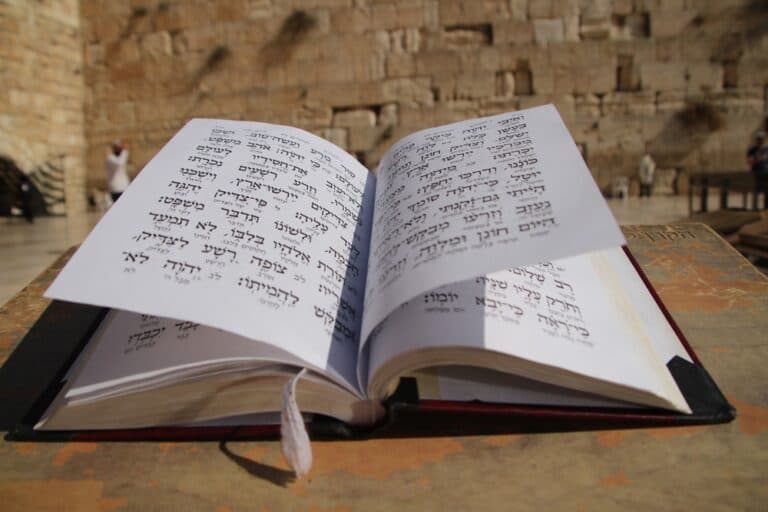

Book of Psalms (Tehillim in Hebrew) at the Western Wall, Jerusalem. | Photo: NECHAMA VID / Shutterstock.com
David succeeded in uniting Israel, defeating its enemies, restoring God to the core of the Israelite conscience, and building a capital in Jerusalem. He spread throughout his kingdom the virtues founded by Abraham ideals he strove to fulfill his entire life: (15) David reigned over all Israel, and David executed true justice among all his people. (II Samuel 8:15)
At the same time, he was engaged in writing what would become the greatest collections of poetic songs to God—Psalms (Tehillim)—which would leave a mark on his own nation and others. It is quite appropriate that the sages chose Psalm 145 as the choicest of all psalms, as it encapsulates his desire to praise and bless God. At three significant points in the psalm, David invokes this word, but each time it builds on the previous until it reaches its crescendo:
(1) I will praise You, my God and king, and bless your name forever. Every day I will bless you and praise your name forever.
(10) All Your works shall praise You O Lord and Your faithful ones shall bless you.
(20) All creatures shall bless His holy name forever and ever.
David begins with a personal blessing of God, and hopes that he will find a way to convince those around him to bless as well. Halfway through the psalm, he succeeds in convincing the righteous ones of the world to bless God. The last verse of the psalm reflects David’s ideal goal in Psalms and perhaps his religious life: that all creations—not just him, not just the Israelites, not just the righteous, but all—will bless God forever.
In this regard, we understand the words of the prophet in depicting the greatness of David and in the transition from verse 10 about David and Israel to verse 11 where a surrounding nation would come and support David and his endeavors:
(10) David kept growing stronger, for the LORD, the God of Hosts, was with him. (11) King Hiram of Tyre sent envoys to David with cedar logs, carpenters, and stonemasons; and they built a palace for David. (12) Thus David knew that the LORD had established him as king over Israel and had exalted his kingship for the sake of His people Israel. (II Samuel 5:10-12)
We also appreciate the actions of King Hiram of Tyre, as he must have sensed the greatness of David and been affected by David’s ‘call’ to God in word and deed. Presumably, he planned to help David build the Temple of God, but when that did not come to fruition, he instead helped David build his own palace. When Solomon, his close friend’s son, sought out his help in order to build the Temple, Hiram’s response is right in line with our story:
(16) Solomon sent this message to Hiram: (17) “You know that my father David could not build a house for the name of the LORD his God because of the enemies that encompassed him, until the LORD had placed them under the soles of his feet. (18) But now the LORD my God has given me respite all around; there is no adversary and no mischance. (19) And so I propose to build a house for the name of the LORD my God, as the LORD promised my father David, saying, ‘Your son, whom I will set on your throne in your place, shall build the house for My name.’ (20) Please, then, give orders for cedars to be cut for me in the Lebanon. My servants will work with yours, and I will pay you any wages you may ask for your servants; for as you know, there is none among us who knows how to cut timber like the Sidonians.” (21) When Hiram heard Solomon’s message, he was overjoyed. “(Barukh Hashem—Blessed be the LORD this day,” he said, “for granting David a wise son to govern this great people.” (I Kings 5:16-25)
Discussion0
No comments yet — be the first to share your thoughts.